


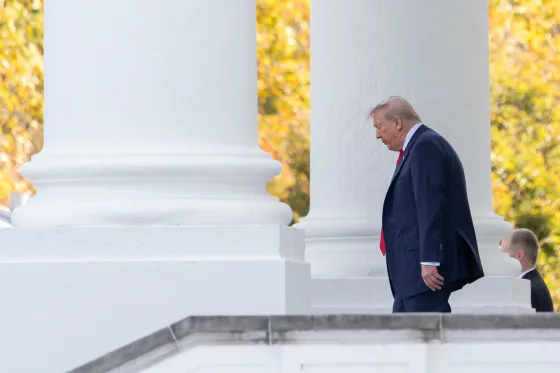
U.S. President Donald J. Trump on Saturday issued one of his strongest foreign policy threats yet, declaring that he has instructed the Pentagon to prepare for “possible military action” in Nigeria if the government in Abuja “continues to allow the killing of Christians.”

In a fiery post on Truth Social, Trump said:
“If the Nigerian Government continues to allow the killing of Christians, the U.S.A. will immediately stop all aid and assistance to Nigeria, and may very well go into that now disgraced country, ‘guns-a-blazing,’ to completely wipe out the Islamic Terrorists who are committing these horrible atrocities. I am hereby instructing our Department of War to prepare for possible action. If we attack, it will be fast, vicious, and sweet, just like the terrorist thugs attack our CHERISHED Christians! WARNING: THE NIGERIAN GOVERNMENT BETTER MOVE FAST!”
The statement, which was later verified by multiple news organizations, marks a dramatic escalation in Washington’s rhetoric toward one of its most important African partners.
The move follows his administration’s decision earlier this week to designate Nigeria as a “Country of Particular Concern (CPC)” under the International Religious Freedom Act, citing what Washington described as “systematic, ongoing, and egregious violations of religious freedom” against Christian communities.
That designation — confirmed by the U.S. Department of State and first reported by Reuters and The Associated Press — places Nigeria among a list of nations accused of allowing or committing severe religious persecution, alongside countries such as Iran and North Korea.
Aid freeze and policy escalation
According to Reuters, Trump said in a separate post that the U.S. government will “immediately stop all aid and assistance to Nigeria” — a move that could suspend hundreds of millions of dollars in annual security and development support. Nigeria has been a top recipient of U.S. counterterrorism assistance aimed at combating Boko Haram and Islamic State West Africa Province (ISWAP) insurgents in the country’s northeast.
The Associated Press (AP) reported that administration officials have been instructed to review all U.S. financial and military cooperation programs with Nigeria. However, no formal directive to initiate military action has yet been issued by the Department of Defense, and the Pentagon has not commented publicly on the president’s order.
Background: violence and religious tensions
Nigeria, Africa’s most populous nation, has faced years of deadly attacks from Islamist extremists and armed bandits, as well as long-running conflicts between Christian farming communities and predominantly Muslim pastoralist groups in the country’s Middle Belt.
Human rights organizations — including Amnesty International and Human Rights Watch — have documented thousands of deaths in such clashes. While Christian communities have suffered heavily in certain regions, analysts stress that violence often affects both Christians and Muslims, and is driven as much by economic and environmental pressures as by religion.
A BBC analysis of Nigerian conflict data indicates that militant attacks have declined in some northern states in 2025 but remain persistent in Plateau, Benue, and Kaduna. Security forces have also been accused of excessive force in response to unrest, drawing criticism from rights groups and Western diplomats.
Nigerian government response
As of Saturday evening, the Nigerian presidency had not issued an official statement, but senior government sources told Al Jazeera that Abuja “strongly rejects the language of threat” and views Trump’s remarks as “an unfortunate distortion of Nigeria’s complex security challenges.”
A senior Nigerian official, speaking anonymously to AP, said: “The Nigerian government protects all citizens, regardless of religion. The suggestion that Christians are being deliberately targeted or that the government tolerates such actions is false and unhelpful.”
International reaction and legal questions
Trump’s comments sparked immediate debate in Washington and among international law experts. Under the U.S. Constitution, the president cannot launch an overseas military operation without congressional authorization, except under limited circumstances defined by the War Powers Resolution.
Legal analysts told The Washington Post that any unilateral military action in Nigeria would likely face bipartisan opposition in Congress and could destabilize U.S. security partnerships across West Africa.
At the United Nations, diplomats from the European Union and African Union expressed concern that Trump’s statement could inflame tensions in Nigeria’s volatile central regions. “This is a deeply sensitive issue that requires diplomacy and humanitarian engagement, not saber-rattling,” said one EU official, speaking to Reuters.
Political and domestic implication
Trump’s remarks also appear to resonate with his conservative evangelical base in the United States, where advocacy groups have for years raised alarms about the persecution of Christians in Africa and the Middle East.
According to Christian Solidarity International, more than 5,000 Christians were killed in Nigeria in 2024, though these figures are contested by local security analysts who argue that many attacks are not primarily religious in nature.
Critics accuse the president of using inflammatory rhetoric for political gain ahead of the 2026 midterm elections, while supporters argue that he is taking a moral stand where previous administrations have failed.
What happens next
As of Saturday night, no new U.S. military orders have been made public, and the Pentagon has not confirmed any preparatory moves for intervention. U.S. State Department officials are reportedly in contact with Nigerian diplomats to “clarify the president’s remarks,” according to CNN.
Analysts warn that even the suggestion of military action could strain relations with Abuja and complicate U.S. operations in Africa, where Nigeria plays a key role in regional security, counter-piracy, and peacekeeping.


Join our Channel...