



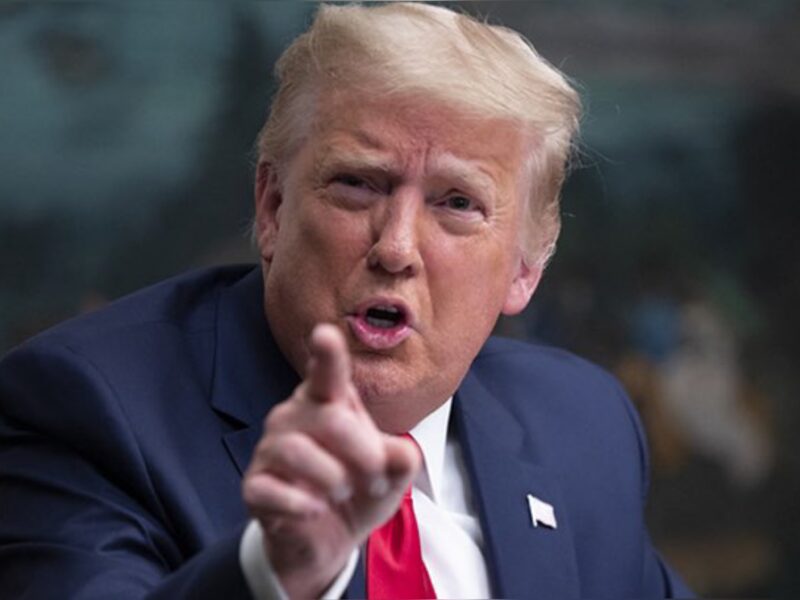
Former U.S. President Donald Trump has once again drawn international attention to Nigeria’s security situation after sharing a video featuring Reverend Ezekiel Dachomo, a Nigerian pastor known for his outspoken claims of targeted violence against Christians in the country.
The video, which circulated widely on social media before being amplified by Trump, shows Pastor Dachomo speaking passionately about what he describes as an ongoing “Christian genocide” in parts of northern and central Nigeria. In the footage, the cleric laments repeated attacks on Christian communities, mass burials, and what he perceives as inadequate governmental response to the violence.
Pastor Dachomo’s Claims and Advocacy
Reverend Ezekiel Dachomo, a regional leader within the Church of Christ in Nations (COCIN) in Plateau State, has become one of the most visible religious voices raising alarm over insecurity in Nigeria’s Middle Belt region. He has repeatedly alleged that Christian communities are being systematically targeted by armed groups, a claim that remains deeply controversial and disputed by various stakeholders.
In previous public statements and viral videos, Dachomo has spoken about conducting multiple mass burials and witnessing repeated attacks on rural communities. He has also appealed to international actors, including global Christian organizations and Western governments, to intervene or apply diplomatic pressure on Nigeria to address insecurity in affected regions.
Trump’s Amplification and International Reaction
Trump’s decision to share the video has reignited an already sensitive global conversation around religious violence in Nigeria. His endorsement of the content aligns with earlier remarks in which he described the situation in Nigeria as a “Christian genocide,” a framing that has been both supported and strongly contested in international discourse.
Supporters of this narrative argue that Christian communities in parts of Nigeria have suffered repeated attacks from extremist and criminal groups. Critics, however, caution that the violence is more complex, involving overlapping ethnic, territorial, and criminal conflicts that affect both Christians and Muslims.
The U.S. politician’s amplification of the pastor’s message has therefore been interpreted in two contrasting ways: as an act of solidarity with persecuted communities, and as a politically charged statement that risks oversimplifying a complex security crisis.
Nigeria’s Security Context and Ongoing Debate
Nigeria has faced years of insecurity driven by multiple armed groups, including insurgent organizations and criminal bandit networks. While some attacks occur in predominantly Christian farming communities, others affect Muslim populations as well, particularly in the country’s north-east and north-central regions.
Analysts and officials have repeatedly emphasized that the violence is not strictly religious in nature, but rather a mix of insurgency, resource conflicts, and organized crime, though religious identity often intersects with these tensions.
Government representatives have consistently rejected claims of an officially sanctioned or systematic “Christian genocide,” maintaining that the state is actively working to combat terrorism and protect all citizens regardless of faith.
Conclusion
Trump’s sharing of Pastor Ezekiel Dachomo’s video has intensified international attention on Nigeria’s security challenges and revived a contentious debate over how the violence should be defined and understood.
While the pastor’s testimony reflects the lived fears of many affected communities, the broader interpretation of the conflict remains highly disputed among governments, religious leaders, and international observers.
As the discussion continues, the situation underscores both the severity of Nigeria’s insecurity crisis and the complexities involved in framing it within global political and religious narratives.

Join our Channel...